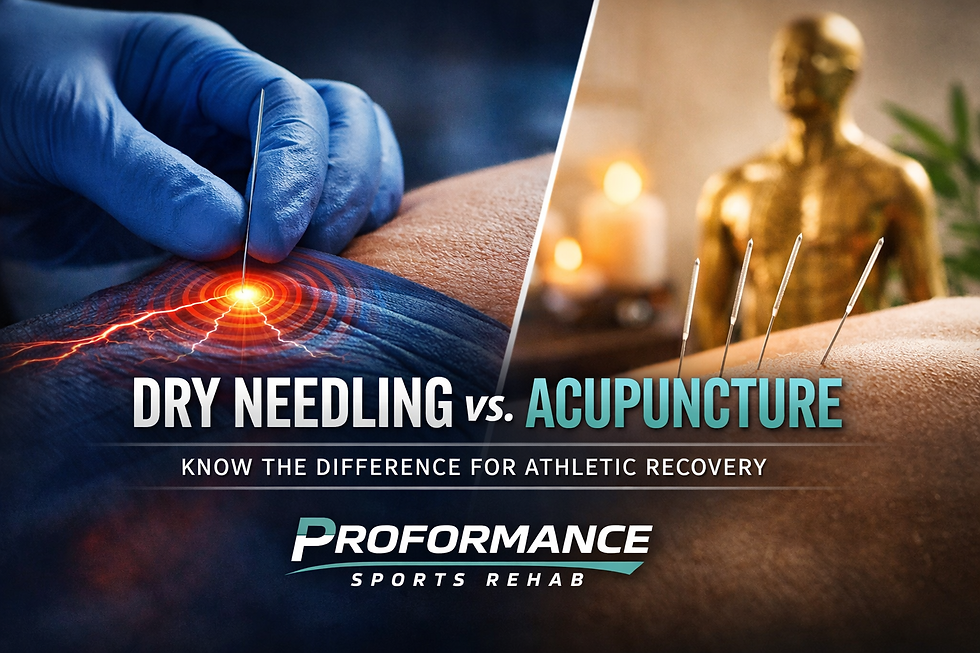
Dry Needling for the 'Weekend Warrior': Quick Recovery
- Proformance SRN

- Feb 18
- 9 min read
Monday morning, 48 hours after an intense pickleball tournament at The PutAway in Severna Park, you can barely lift your arms to wash your hair. Your calves feel like concrete blocks. Your lower back radiates that deep, unrelenting ache that makes sitting at your desk miserable. You played six matches Saturday, pushed through the fatigue, and now you're paying the price with delayed onset muscle soreness (DOMS) that will plague you until Wednesday or Thursday—assuming you do nothing about it. This is the weekend warrior pattern we see constantly at Proformance Sports Rehab in Annapolis: active adults who compress their weekly activity into weekend marathons, then struggle through days of debilitating muscle soreness that interferes with work and daily life. Traditional treatments—ice, foam rolling, massage—provide marginal relief that develops slowly over days. But there's a faster solution that most players don't know exists: trigger point dry needling. This evidence-based intervention rapidly resets muscle tone, releases fascial restrictions, and accelerates recovery so you're back to baseline in 24 to 48 hours instead of four to five days. Here's how dry needling transforms recovery for Anne Arundel County's court athletes.
What Is Dry Needling: The Mechanism Behind Rapid Relief
Let's start by clarifying what dry needling is and isn't. Dry needling involves inserting thin filiform needles—similar to acupuncture needles—directly into myofascial trigger points and taut muscle bands. Despite using similar needles, dry needling is fundamentally different from traditional acupuncture.
Acupuncture derives from Traditional Chinese Medicine, based on meridian theory and chi energy flow concepts. Practitioners place needles at specific points along meridians to restore energy balance. Dry needling operates on Western medical principles—neuroanatomy, muscle physiology, and pain science. We target trigger points identified through palpation and movement assessment, aiming to create specific neurophysiological responses.
Myofascial trigger points are hyperirritable spots within taut bands of skeletal muscle. Research demonstrates these points exhibit spontaneous electrical activity, localized muscle fiber contraction, and reduced blood flow. They're painful to palpation and refer pain to distant areas in predictable patterns.
When a needle penetrates a trigger point, several mechanisms create therapeutic effects. The mechanical disruption breaks up contracted muscle fibers and fascial adhesions. The needle insertion creates a local twitch response—a brief, involuntary contraction followed by immediate relaxation. This twitch represents a spinal reflex that resets the motor endplate, the junction where nerve meets muscle.
The needle also creates microtrauma that initiates healing cascades. Blood flow increases to the area, bringing oxygen and nutrients while removing metabolic waste products that accumulated in the ischemic trigger point. This vascular response accelerates tissue recovery.
Neurophysiologically, needling creates a barrage of afferent input that modulates pain perception through gate control mechanisms and descending pain inhibition. The combination of local effects—improved blood flow, reduced muscle tension—and central nervous system modulation creates rapid symptom relief.
The Weekend Warrior Pattern: Why You Get So Sore
Understanding why weekend athletes develop severe soreness helps explain why dry needling works so effectively.
During intense or prolonged exercise, your muscles experience microtrauma—microscopic tears in muscle fibers and connective tissue. This damage triggers an inflammatory response that peaks 24 to 72 hours post-exercise, creating the delayed onset muscle soreness (DOMS) that plagues you Monday through Wednesday.
The weekend warrior pattern amplifies this process. You're relatively inactive during the week—sitting at a desk job in Annapolis or Odenton—then suddenly subject your muscles to four to six hours of intense activity Saturday and Sunday. Your tissues haven't adapted to this loading, lacking the conditioning that regular training provides.
Additionally, accumulated fatigue during extended tournament play creates compensation patterns. Your prime movers fatigue, forcing synergist muscles to work harder than they're conditioned for. Your stabilizing muscles exhaust, allowing joint positions to drift outside optimal ranges. These factors create eccentric loading—lengthening contractions under tension—that causes the most severe muscle damage.
After the tournament at Pip Moyer Recreation Center, your muscles develop protective guarding—sustained low-level tension intended to splint damaged tissue. This guarding creates the stiffness and restricted range of motion you experience. Trigger points form within these guarded muscles, perpetuating pain and dysfunction beyond the normal healing timeline.
Traditional recovery methods—rest, ice, gentle stretching—slowly reduce inflammation and allow tissue healing over four to five days. But they don't directly address trigger points or muscle guarding. Dry needling targets these specific dysfunctions, creating more rapid symptom resolution.
Common Trigger Point Patterns in Pickleball Players
Pickleball creates predictable trigger point patterns based on the sport's specific movement demands. Identifying these patterns allows targeted treatment.
Upper trapezius trigger points develop from sustained shoulder elevation during paddle readiness and overhead shots. These points create neck pain and headaches—the tension headache many players experience after long sessions. The referred pain pattern extends into the temple and base of the skull.
Levator scapulae trigger points result from looking up repeatedly during lob exchanges. This muscle connects your neck to your shoulder blade. Trigger points create that characteristic stiff neck feeling where you cannot turn your head without rotating your entire torso.
Rotator cuff trigger points—particularly in infraspinatus and subscapularis—develop from repetitive paddle swings. These create deep shoulder ache that's often misdiagnosed as rotator cuff tears. The pain pattern extends down the arm, sometimes reaching your hand.
Forearm extensor trigger points cause the elbow pain many players attribute to lateral epicondylitis (pickleball elbow). While tendinopathy may coexist, trigger points in the extensor mass significantly contribute to symptoms and respond rapidly to needling.
Gluteus medius and minimus trigger points develop from the lateral movements and split-step landings pickleball demands. These create hip and buttock pain that's often confused with hip joint pathology. The referred pain can extend down the lateral thigh, mimicking sciatica.
Gastrocnemius and soleus trigger points cause the calf pain and tightness that plagues players after extended court time. These points create that concrete-block feeling in your calves that makes morning stairs a challenge. They also contribute to Achilles pain and plantar fascia symptoms.
Quadratus lumborum trigger points create low back pain from the sustained flexed posture at the kitchen line. This deep back muscle connects your ribs to your pelvis. Trigger points create that characteristic deep, unrelenting back ache that's worse with sitting and bending.
The Dry Needling Session: What to Expect
Understanding the dry needling process helps reduce apprehension and optimize outcomes.
During your comprehensive evaluation at Proformance, we identify specific trigger points through palpation, range of motion testing, and movement assessment. We correlate your symptom pattern with known referred pain patterns to confirm trigger point involvement.
We position you comfortably with the target muscle accessible and slightly stretched. Clean the skin with alcohol. Then insert the needle through the skin directly into the trigger point. The needle insertion through skin creates brief discomfort—a quick pinch. Most patients tolerate this easily.
When the needle contacts the trigger point, you'll likely experience a local twitch response—that involuntary muscle contraction. This feels like a deep cramp or muscle grab that lasts 1 to 2 seconds. The twitch indicates we've successfully contacted the dysfunctional motor endplate. While momentarily uncomfortable, it represents the therapeutic mechanism creating your recovery.
We may manipulate the needle to elicit additional twitches or simply leave it in place for 10 to 30 seconds allowing passive release. Multiple trigger points are typically treated during a single session—we might needle 6 to 12 points across several muscles.
After needling, the treated area feels achy—similar to post-workout soreness but less intense. This soreness peaks within hours and resolves within 24 to 48 hours. During this period, your original symptoms simultaneously improve. By day two or three post-needling, both the treatment soreness and your original pain have substantially resolved.
Post-treatment recommendations include hydration (promoting metabolic waste clearance), gentle movement within comfortable ranges (preventing stiffness), and avoiding intense activity for 24 hours (allowing tissue recovery from the treatment microtrauma).
The Evidence: What Research Shows
Dry needling has evolved from alternative practice to evidence-based intervention supported by substantial research.
A systematic review in Pain Medicine analyzing multiple randomized controlled trials found that dry needling significantly reduces pain and improves function in musculoskeletal conditions compared to sham needling or no treatment. Effect sizes were moderate to large, particularly for neck and shoulder pain—exactly what pickleball players experience.
For lateral epicondylalgia (tennis/pickleball elbow), research demonstrates that dry needling combined with exercise produces superior outcomes compared to exercise alone. The needling accelerates initial pain reduction, allowing earlier progression through rehabilitation.
Studies examining delayed onset muscle soreness show that dry needling reduces pain intensity and improves range of motion faster than passive recovery. Research in the Journal of Sports Sciences found that athletes treated with dry needling post-exercise returned to performance baseline 24 to 36 hours faster than control groups.
Imaging studies using ultrasound and MRI demonstrate that dry needling increases blood flow to trigger points, validating the proposed ischemia-relief mechanism. Electromyographic studies confirm that needling reduces spontaneous electrical activity in trigger points, supporting the motor endplate dysfunction model.
Safety data shows dry needling carries minimal risk when performed by trained practitioners. Serious adverse events are extremely rare. Common minor effects—temporary soreness, occasional bruising—resolve quickly without intervention.
Integrating Dry Needling with Comprehensive Treatment
While dry needling provides rapid symptom relief, optimal outcomes require integrating needling with comprehensive treatment addressing underlying causes.
At Proformance, we use dry needling as one component within our 75-minute one-on-one sessions. After needling acutely painful trigger points, we immediately address movement dysfunctions and strength deficits that created those trigger points.
If you developed upper trap trigger points from poor scapular mechanics, needling provides immediate relief but won't prevent recurrence. We combine needling with scapular stabilization exercises targeting your lower trapezius and serratus anterior. This combination eliminates current symptoms while building resilience against future problems.
If calf trigger points stem from inadequate warm-up and poor recovery habits, needling treats the immediate problem while we educate you about proper preparation and post-play protocols. We might demonstrate eccentric calf strengthening that prevents trigger point recurrence.
We also integrate nutritional strategies that optimize recovery. Adequate protein intake, anti-inflammatory dietary patterns, and proper hydration all influence muscle recovery rates. Our comprehensive approach addresses mechanical, metabolic, and behavioral factors simultaneously.
Preventive Needling: Staying Ahead of Problems
While most players discover dry needling when seeking treatment for existing pain, some athletes use it proactively for performance optimization and injury prevention.
Latent trigger points exist in muscles without causing symptoms but limit range of motion, reduce muscle performance, and increase injury susceptibility. Proactive treatment of latent trigger points before they become symptomatic optimizes function and prevents future problems.
Athletes preparing for major tournaments sometimes schedule pre-event dry needling sessions. Treating accumulated trigger points before intense competition improves range of motion, reduces muscle tension, and ensures optimal performance readiness.
Post-tournament recovery sessions using dry needling accelerate return to baseline, reducing the recovery time before you can train or compete again. For players at Severna Park Community Center competing in multiple tournaments monthly, this recovery acceleration provides significant performance advantages.
Who Benefits Most from Dry Needling
While dry needling helps many patients, certain profiles respond particularly well.
Weekend warriors—players who compress weekly activity into intense weekend sessions—benefit enormously. The rapid recovery needling provides allows you to maintain your playing schedule without accumulating dysfunction.
Players with chronic muscle tension and stiffness despite stretching and self-massage find dry needling addresses issues that surface treatments cannot reach. Trigger points deep within muscle bellies remain inaccessible to foam rolling but respond immediately to needling.
Athletes with persistent pain patterns that haven't responded to traditional physical therapy often have significant trigger point components that previous treatment missed. Adding dry needling to their program creates the breakthrough that allows progress.
Older athletes whose recovery takes progressively longer benefit from any intervention that accelerates healing. The multi-day soreness that would sideline you for half a week becomes manageable 24 to 48-hour discomfort.
Contraindications are few but important. We don't needle patients with bleeding disorders, those on anticoagulation therapy in certain anatomical areas, or those with active infections. Pregnancy requires modified approaches. Local skin conditions prevent needling at specific sites.
Your Action Plan: Five Recovery Strategies
Implement these strategies to optimize recovery whether or not you pursue dry needling:
1. If you regularly experience severe multi-day soreness after weekend play, schedule a dry needling evaluation. This intervention specifically targets the weekend warrior pattern and can dramatically reduce recovery time.
2. Distribute your playing volume more evenly throughout the week rather than clustering sessions on weekends. This single behavioral change reduces soreness by preventing the sudden loading spikes that create severe tissue trauma.
3. Implement proper warm-up protocols before play and recovery routines afterward. These strategies reduce injury and soreness even without professional intervention.
4. Build a base level of strength and conditioning through regular training rather than relying solely on playing for fitness. Better-conditioned athletes experience less soreness from competition.
5. If you have chronic pain that hasn't responded to traditional treatment, consider that trigger points may be a significant component. Schedule a comprehensive evaluation that includes trigger point assessment.
Why Proformance for Dry Needling in Anne Arundel County
Dry needling effectiveness depends heavily on practitioner skill and comprehensive treatment integration. At Proformance Sports Rehab, we've made dry needling a cornerstone of our treatment approach for court athletes.
Our therapists complete advanced dry needling certification through recognized programs, providing the anatomical knowledge and technical skill required for safe, effective treatment. We understand trigger point referral patterns, anatomical landmarks, and needling techniques that optimize outcomes.
We integrate dry needling within comprehensive 75-minute sessions that address all factors affecting your recovery. You're not just getting needled—you're receiving skilled manual therapy, targeted exercise prescription, movement retraining, and performance optimization strategies.
Whether you're recovering from an intense weekend at The PutAway or preparing for upcoming competition at Pip Moyer, we'll design a treatment plan that gets you back to peak performance quickly. Don't accept days of debilitating soreness as inevitable. Schedule your dry needling evaluation today and discover why Anne Arundel County's most serious court athletes trust Proformance for rapid, effective recovery.